Sara Masarone, Senior ML Researcher/Engineer at Ignota Labs
Currently: Senior ML Researcher/Engineer at Ignota Labs - 2023 - 2026
I’m an Senior ML engineer/researcher building applied AI systems for drug discovery, currently at a biotech startup. My work spans foundation-model-based molecular property prediction, where I’ve worked on models that leverage large-scale pretraining to improve generalisation across chemical space, and agentic systems for target identification and review, automating parts of the early discovery pipeline that traditionally required manual literature and data triage.
I’ve also led multi-omics data integration efforts, partnering with external providers like OASIS and Cytochroma to combine heterogeneous biological data sources into unified representations that support downstream modeling and decision-making. This work sits at the intersection of ML engineering and computational biology, requiring both rigorous model development and close collaboration with wet-lab and data science teams. As a company, we focus on using our internal tech to rescue failed drugs, allowing more molecules to reach the market, thus benefitting more patients!
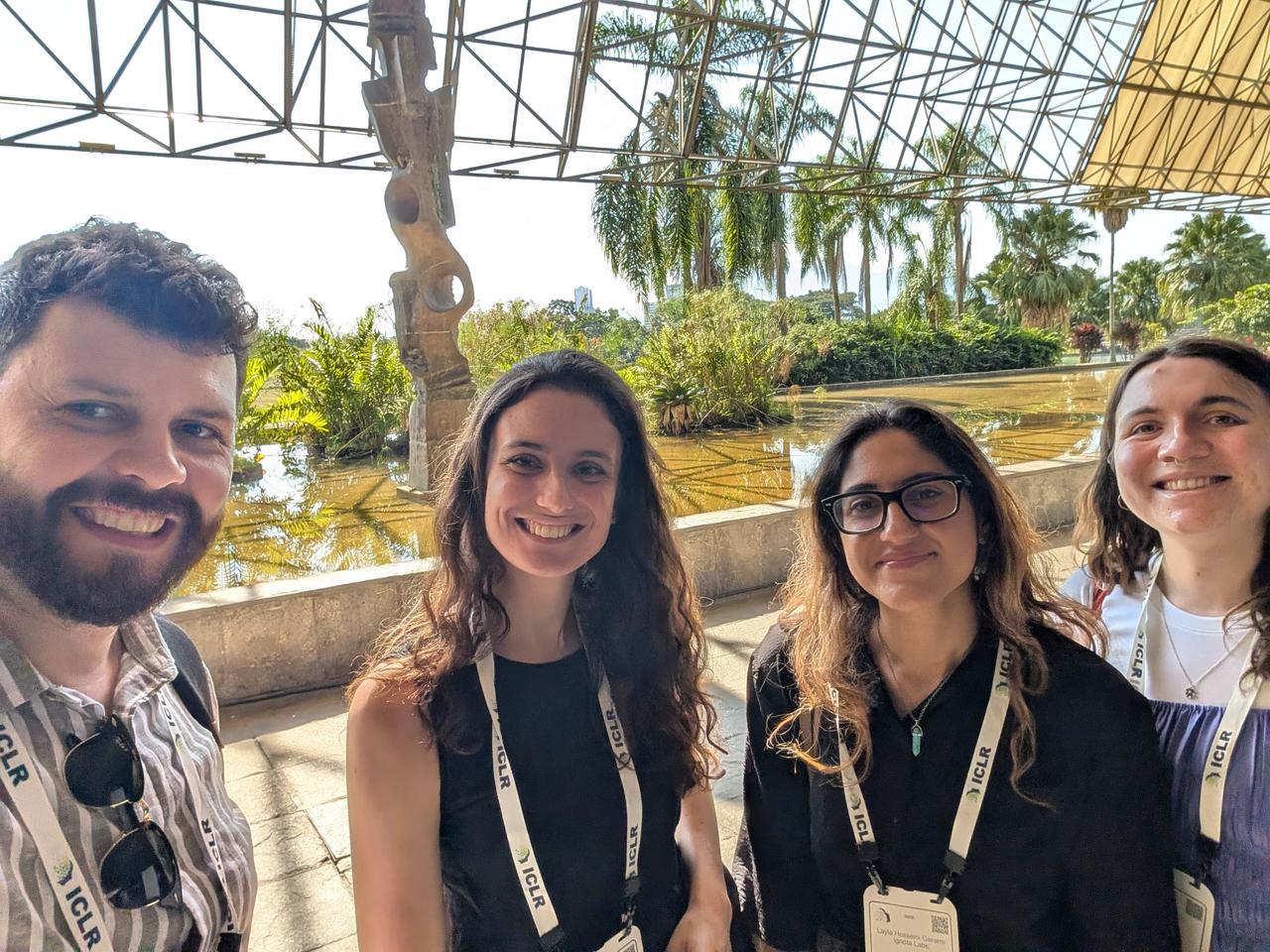
You can check out our latest workshop papers presented at ICLR in April (see pic below)!
PhD Awarded!!! - 2023
I submitted my PhD at the Alan Turing Institute and Queen Mary University of London in November 2023. My PhD project focused on Machine Learning appliacations to Precision Medicine. In particular, my project looked at understanding the immune system of trauma patients in order to provide treatment when it gets dysregulated. More broadly, I’m interested in using data-driven methods (both supervised and unsupervised) to disentangle complex biological signals and understand the pathophysiology of immune-driven diseases. I’ve previoulsy worked on multi-omics data integration appraches and representaton learning both in industry and academia. Recently, under the supervision of Prof Barnes and Prof Pennington, I’ve also been involved in developing predictive models for the identification of therapeutic targets/predictive biomarkers to provide diagnosis and treatment to patients affected by these conditions.
 |
 |
Work experience
Senior ML Researcher at Ignota Labs - Drug toxicity (February 2025 – present)
- Developed and maintained molecular property prediction model on GCP, from prototype through to production.
- Contributed to company tech strategy and planning as part of the senior team, shaping direction across ML, bioinformatics and cheminformatics.
- Developed multi-omics models to identify and prioritise toxicity signatures, integrating molecular and biological data.
- Worked on orchestrating agentic lab-in-the-loop systems, automating workflows across the lab and our internal ML pipeline.
- Collaborated on patent scraping pipelines to support IP and competitive landscape analysis.
- Managed external partnerships, grants and consortium projects, including Sanofi and OASIS, and line-managed and mentored an intern.
ML Researcher at Ignota Labs - Drug discovery (April 2024 – February 2025)
- Worked on ML for safety: e.g. GNN to predict drug–adverse events relationships.
- Tech: Graph Neural Networks, Knowledge Graphs, Google Cloud/AWS, Python, Testing, Biological data processing, Omics.
ML Engineer at Ignota Labs (Internship) - Drug discovery (November 2023 – April 2024)
- Brought biological data modelling expertise into a cheminformatics team, developing ML models and
Part-time ML Engineer at Inflammatix (California, USA): I worked as part-time Machine Learning Engineer on Representation Learning. My work focused on the use of generative models such as Variational AutoEncoders to capture meaningful structure in the data.
Intern at Inflammatix (USA): Interned during summer 2021 at Inflammatix as ML Engineer. My work focused on data harmonisation and the development of a framework for the company.
ML Learning Tutor at Cambridge Spark: Tutored various Machine Learning courses at Cambridge Spark including: “Introduction to Machine Learning”, “Supervised Learning 1 and 2”, “Unsupervised Learning”, “Ensembles”, “Data visualisation”, “Drata Wrangling”, “Python and Pandas”.
ML Summer School at Oxford (2020) OxML Summer School organised by Saïd Business School (Oxford University), AI for Global Goals, Deep Medicine (Oxford University) and CIFAR. 17th - 25th of August
Publications and Reports:
- Masarone, Sara, Katie Victoria Beckwith, et al. (Apr. 2026). “Agentic Orchestration of Drug Discovery ML Tools Under Partial Observability”. In: Learning Meaningful Representations of Life (LMRL) Workshop at ICLR 2026. pdf
- Masarone, Sara, Alex Beeson, et al. (Apr. 2026). “Generating a Novel Dataset for Mechanisms of Drug-Induced Toxicity using LLM-supported tools”. In: Learning Meaningful Representations of Life (LMRL) Workshop at ICLR 2026. pdf
- Masarone, Sara, Katie V Beckwith, et al. (Apr. 2025). “Advancing predictive toxicology: overcoming hurdles and shaping the future”. In: Digital Discovery. link
- NG, Sandra et al. (Apr. 2023). “The benefits and pitfalls of machine learning for biomarker discovery”. In: Cell and Tissue Research. link
- Masarone, Sara (Oct. 2022). “Representation Learning to Effectively Integrate and Interpret Omics Data”. In: NeurIPS AI for Science workshop. pdf
- October 2021 - Report for the Data Study group 2020
News and posters
- April 2026 ICLR in Rio: 2 first author posters on Agentic systems and benchmarks
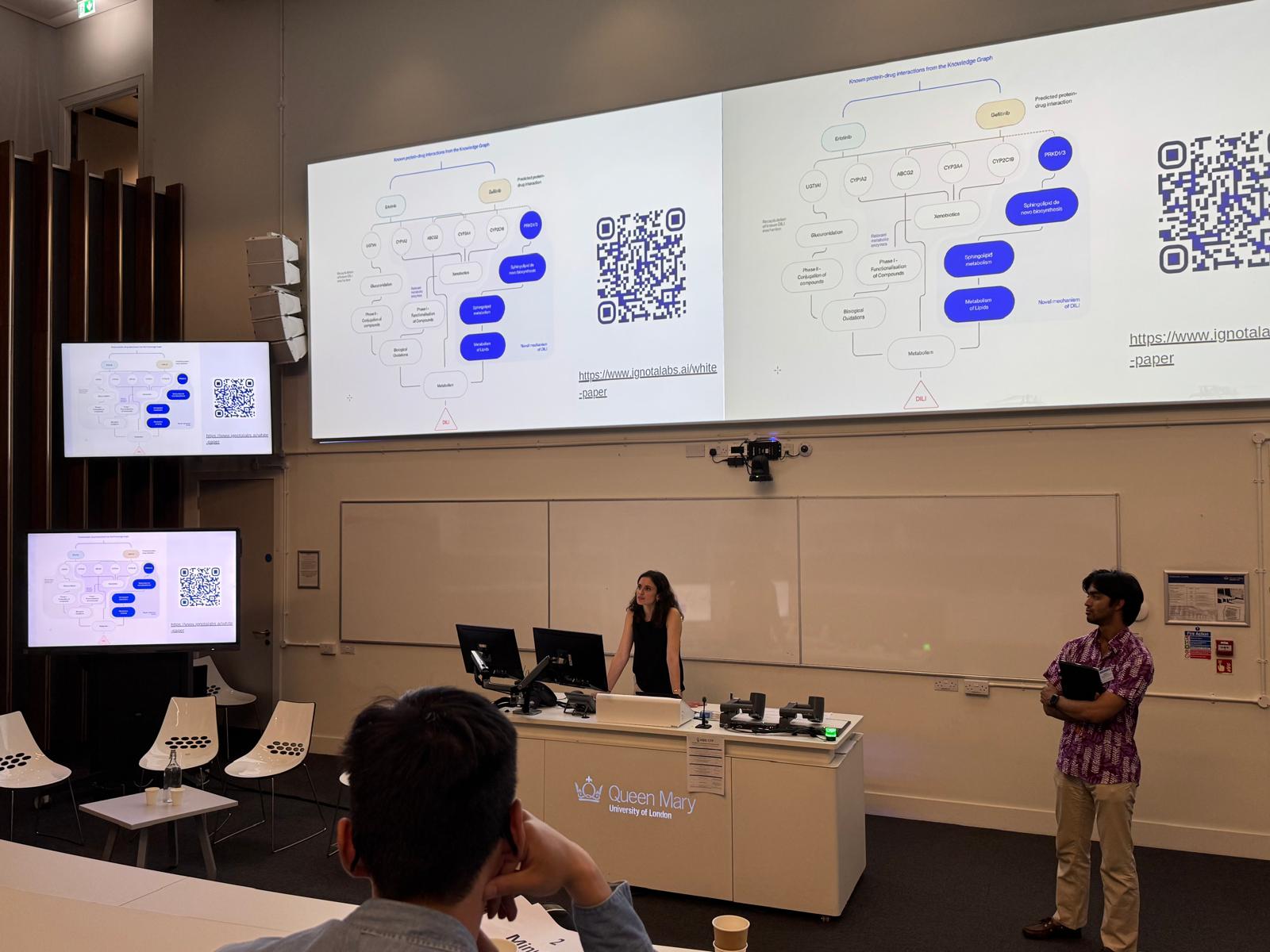
- June 2025 - Invited speaket at QMUL - Agentic AI in drug discovery
- August 2023 - New Paper: “The benefits and pitfalls of machine learning for biomarker discovery”
- August 2023 - Submitted PhD!!!
- October 2022 - NeurIPS paper accepted at AI for Science NeurIPS workshop! (conference in Nov-Dec)
- October 2022 - Talk at CSHL on regularisation methods for VAEs (conference in Nov)
- October 2022 - Poster at CSHL “A deep learning approach to integrate different data modalities and improve patient stratification in trauma”
- July 2021 - Poster presentation at ISMB/ECCB: “Developing of an objective proteomic indicator of trauma severity”
- May 2021 - Talk at the Blizard Institute: “Data driven approaches to understand the hyperacute window of trauma patients”
- October 2020 - Poster at William Harvey Research Institute Annual Review - “What similarities are there between trauma, sepsis and covid?”
Other Projects
-
Created a package called EnrichOmics to automate workflowes in bioinformatics. The package allows to use the EnrichR and OpenTargets APIs to get quick results without having to copy-paste lists of genes to their websites. Info can be found on PyPI. Docs can be found here(2022)
-
Project on Explainable AI: Communicating high-street bakery sales predictions using counterfactual explanations (2021) This challenge aimed to help CatsAi better serve their client (a large wholesaler) to estimate bakery orders to reduce waste and under delivery. The main tasks were to predict high-street sales based on meteorological factors and apply explainability techniques to effectively communicate their outputs to the client. Research questions we wanted to answer were:
- Which features are predictive of sales (i.e. orders placed to the warehouse)?
- Powerful predictive models are often difficult to interpret. Can we explain which features are important to a business owner? (XAI)
-
Tutorial for Apocrita (QMUL’s cluster) (2020) Developed a tutorial to help other researchers at QMUL to use array jobs on the cluster and speed up their analyses.
-
Contributed to a project for Dementia Platform UK to implement models that allow clinicians to understand drivers of dementia and predict Alzheimer using a large cohort of patients.